
Microsoft Entra/Azure Portal: App registration pane versus Enterprise application pane

Difference between registering an application in the app registrations pane and adding an application in the enterprise applications pane in Microsoft Entra admin center or Azure portal.

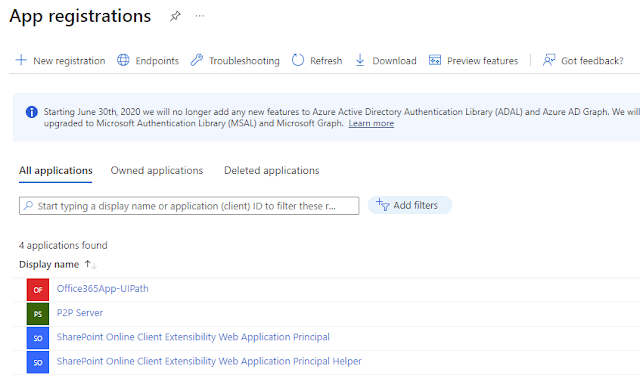
App registration is a way of reserving an app and URL with Azure Active Directory (Azure AD/Microsoft Entra), allowing it to communicate with Azure AD, hooking up any reply URLs, and enabling Azure AD services on it. When we have an application that we're developing and want to integrate it with Azure, we need to register our application in app registrations, where we'll configure the reply URL, logout URL, and API access, if needed. When we register our application, Azure AD assigns a unique application ID to it and lets us add certain capabilities, such as credentials, permissions, and sign-ins. The default settings allow only users from the tenant under which our app is registered to sign in to your application.

App Registration Pane
App Registrations Pane


New App Registration screen
New App registration screen


It's possible to confuse the Enterprise applications pane with the App registrations pane because the enterprise applications pane contains the list of our service principals. However, the term Enterprise app generally refers to applications published by other companies in the Azure AD gallery that can be used within the organization/tenant.
Enterprise applications screen

For example, if we want to integrate Facebook and manage single sign-on (SSO) within our organization, we can integrate it from the enterprise applications dropdown list in the applications pane. Our own applications will also be represented in the enterprise applications pane as service principals, which are instantiations of our applications in the tenant.

The following screen shows the Azure AD gallery which is opened when we click New Application from Enterprise apps screen.

Azur AD Gallery - Enterprise apps


If we don't find the application in the gallery, we can create out own Enterprise application by clicking the Create your own application from the Azure Ad Gallery page:

Create your own application - Enterprise apps

Comments

Popular posts from this blog

Difference between the architectures of SSPs and SharePoint Service Application

SharePoint 2010 has some new features and components, which help to overcome difficulties such as redundancy and service-sharing that we faced while using SharePoint 2007.  Services in MOSS 2007 were implemented with the help of Shared Service Providers or SSPs. But we cannot use the services of one SSP for another SSP. So each SSP has to have its own set of services and applications, which increases redundant data in the farm.  For example, different managers in the same organization use a SharePoint site to maintain official data associated with an SSP. This SSP is associated with different services, such as Search service, BDC service, and a user profile service. A project manager in this organization requests an exclusive user profile service to maintain project data security. To provide this, we first need to create a separate SSP for the project manager and then a separate service called user profile service - project name. Next, we need to associate the SSP with ...

SharePoint Designer Workflow Failed to Start - Cancelled by System Account

I was working on a List workflow the other day in SharePoint Designer 2010. This list already had a workflow which was working perfectly fine and I needed another manual workflow in it. No matter what I tried the workflow would fail and would log a message in the history list that Workflow failed to start and it was cancelled by System Account . I observed that the same happened with new workflows in that list, new workflows in other lists and I even tried creating new subsites and workflows were behaving the same way. I googled for a while and there were many suggestions to clear SPD cache which did not help me. I played with SPD 2010 for a while and observed that the workflow xml and xoml files were checked out. I read in some blogs that this could cause this issue as well. I tried to check those files in but then I was greeted with a new error! " Cannot perform this operation. The file is no longer checked out or has been deleted ." I had no clue what was happening...

Document Property disabled under Quick Parts in Word 2010

Document Property under Quick Parts sometimes appears grayed out or disabled in Word client and we can see that Compatibility mode written on the Word client on the top part. This happens because Word disables certain features to make our document compatible with previous versions of Office. To workaround we have to change the compatibility feature. To do that click File on the Word ribbon and select Info. Click on Convert button and click OK on the pop up message. This enables the disabled features and now we can access the Document Properties under Quick Part.